A Liminal Spaces Reflection
There’s a particular silence that settles between two people when they’ve reached the limits of what they can articulate. It isn’t anger, and it isn’t surrender. It’s something like standing at the edge of a desert road with no signs, no promises, and no way to know whether the horizon is an invitation or a warning.
That’s the silence your two characters inhabit.
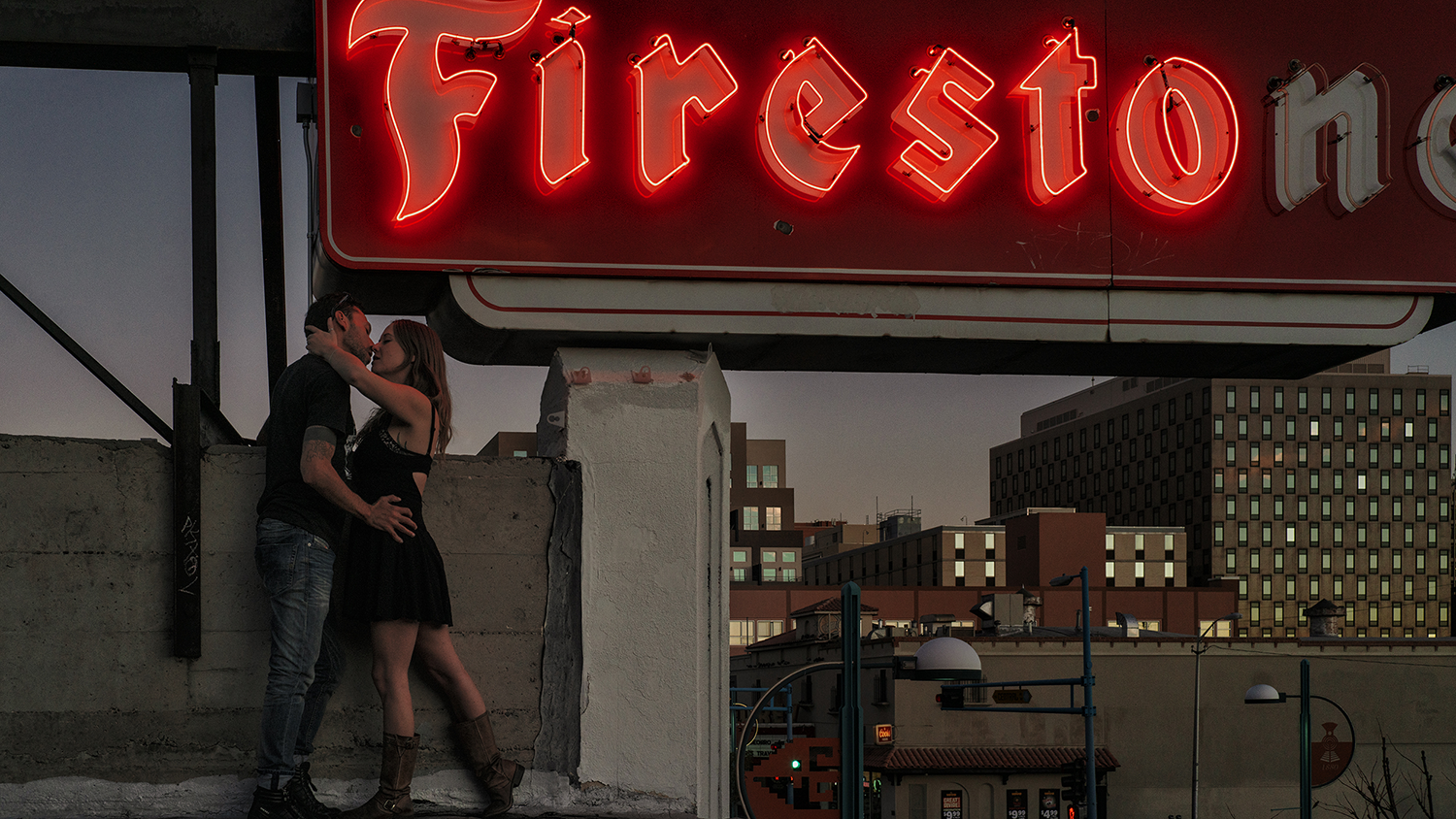
At first glance, they appear to be a couple caught in an unresolved tension — lovers, perhaps, or partners, or something harder to name. But the more time one spends with them, the clearer it becomes that they are not just two individuals moving through the American Southwest. They are the country itself, split into two wandering halves, each trying to remember the direction home.
Their distance is our distance.
Their hesitation is our hesitation.
Their longing is the faint hum beneath the static of Western life over these last few years.
The Space Between Them
Even when the pair stands inches apart, something invisible lingers in the space between. It’s not quite conflict — more like the echo of a conversation that society meant to have with itself but never finished.
One half looks outward, scanning the horizon as though the answer must be waiting somewhere beyond the next bend.
The other half looks inward, trying to hold onto whatever remains familiar.
Together, they move — but rarely in sync.
Together, they hope — but rarely for the same thing.
This dissonance mirrors a nation that has spent the last several years oscillating between nostalgia and reinvention, certainty and doubt, wanting to accelerate into the future while clinging to the comfort of what once felt solid.
Since 2020, many felt the world snap awake in a way that exposed every hairline fracture. The couple carries that fracture within their posture. They are trying not to break, not to drift apart, not to admit they no longer see the landscape the same way.
They are the American psyche at a crossroads.
Two Archetypes, One Story
It doesn’t matter whether viewers interpret the man as resolve or exhaustion, or the woman as hope or disillusionment. The exact mapping isn’t the point. What matters is that, together, they represent the dual nature of Western identity:
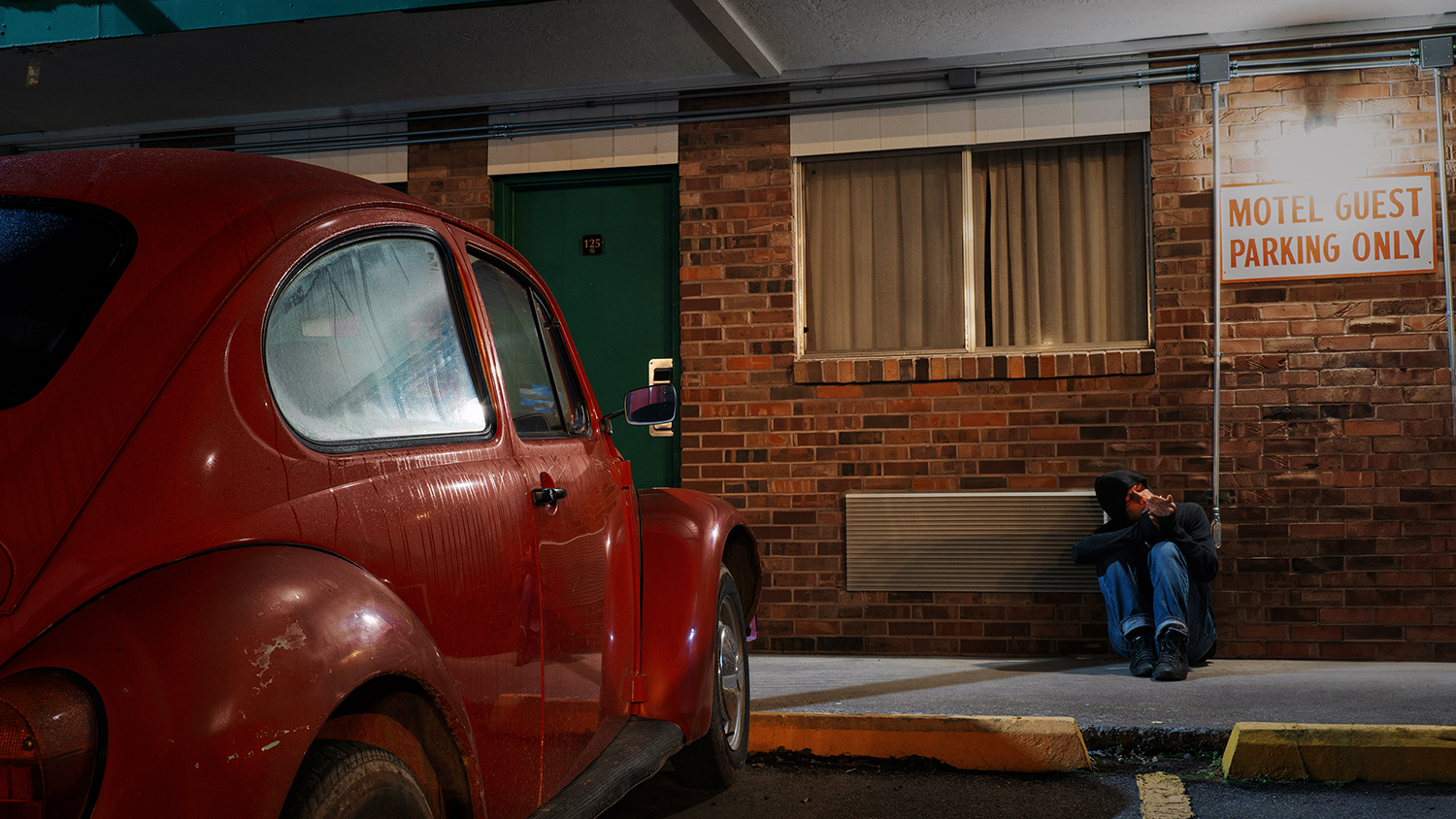
- the part of us that wants to believe the Dream is still out there, hiding behind the next gas station or motel sign.
- and the part that already knows the Dream has been wandering just as aimlessly as we have.
They walk through abandoned structures, half-lit rooms, and desert highways because so has the country. The infrastructure frays. The systems groan. The future doesn’t arrive on cue. And the couple does what so many of us have done in these years of quiet reevaluation:
they keep moving anyway.
Not because they know where they’re going
but because stopping feels too close to giving up.
The Age of Unsure Footing
The couple’s uncertainty mirrors a broader cultural truth:
Western society, for the first time in a long time, no longer walks with unearned confidence. Instead, it moves like two people trying to navigate a dark room with a single flashlight.
Every choice feels like guesswork.
Every direction feels like a test.
Every shadow feels heavier than it used to.
The couple embodies this shift.
They are not symbols of failure; they are symbols of transition.
They are what happens when a culture wakes from a long dream of certainty and must now relearn how to stand.
Why They Stay Together
Strangely — beautifully — the couple never fully separates.
Even in their distance, they remain bound by an unspoken alignment: an understanding that wandering together is still better than wandering alone. This echoes the deeper instinct woven into Western identity — a recognition that, despite all division and disillusionment, there is still a shared story here.
Maybe it’s fractured.
Maybe it’s unresolved.
But it’s shared.
The couple keeps going because some part of them believes the landscape will eventually make sense again. Or at least that they will learn how to make sense of it themselves.
That belief — fragile, flickering, stubborn — is what keeps a nation from dissolving.
A Country in Human Form
The couple isn’t meant to be read as heroes or victims. They are ordinary. And that ordinariness is precisely what makes them mythic.
They are:
- the lost road trip we didn’t know we were on,
- the relationship with our own country we didn’t know we were having,
- the quiet fear that tomorrow might not look like yesterday,
- and the quiet hope that maybe that’s not entirely a bad thing.
In the end, their journey is not about escape.
It’s about recognition.
Recognition that the myth of stability was always a myth.
Recognition that nations, like relationships, drift and return, fracture and heal, wander and rediscover themselves.
Recognition that being lost together is still a kind of belonging.
The couple is America — not in its triumph, but in its liminality.
Not in its certainty, but in its search.
Not in its perfection, but in its willingness to keep walking, even when the signs have faded and the horizon refuses to answer.